
The Italian Ballerina by Kristy Cambron: Book Review
Looks Like Books contains affiliate links and is a member of the Amazon Services LLC Associates Program. If you make a purchase using one of these affiliate links I may receive compensation at no extra cost to you. See my Disclaimer to learn more.
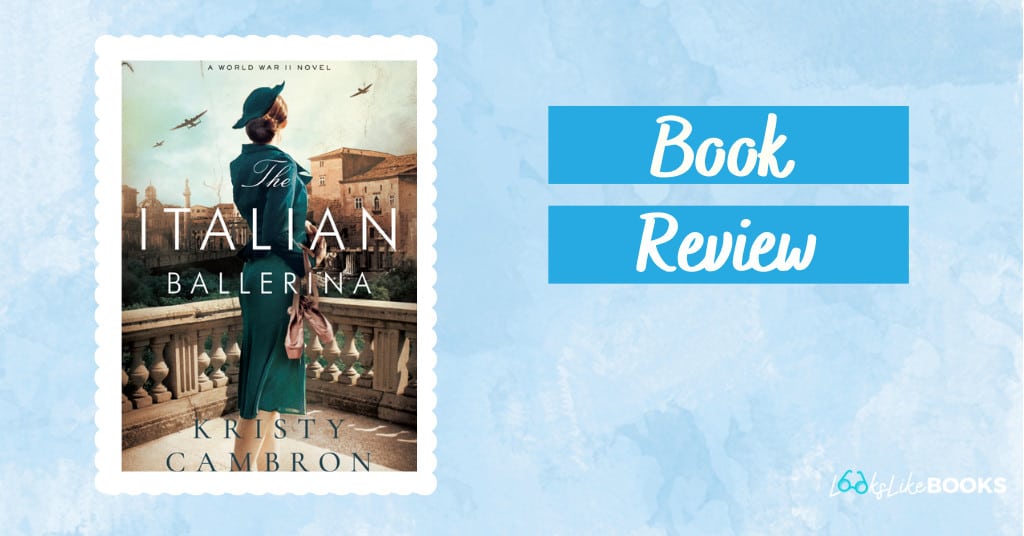
The Italian Ballerina by Kristy Cambron combines two things that immediately caught my attention: WWII historical fiction and ballet. But what really made this book memorable for me was discovering a piece of wartime history I had somehow never encountered before.
The novel is inspired in part by the true story of Syndrome K, a fictitious disease invented at a hospital in Rome to help protect Jewish people from the Nazis. Considering how much WWII historical fiction I read, I’m always impressed when a novel sends me off to learn about something completely new – and this one certainly did.
For readers who enjoy dual-timeline historical fiction based around lesser-known true events, there’s a lot to like here.
My Take: The Italian Ballerina gave me one of my favorite things historical fiction can offer: a story I enjoyed along with a piece of history I knew almost nothing about. The real-life story behind Syndrome K fascinated me, while the WWII Italian setting, dual timelines, and ballet added even more to the novel. My verdict? Read. The multiple wartime timelines confused me occasionally, but not enough to keep this from being a book I thoroughly enjoyed.

What The Italian Ballerina Is About
The Italian Ballerina moves between present-day and WWII-era Italy, connecting several people whose lives become entwined with a remarkable effort to save Jewish Italians during the Nazi occupation of Rome.
In 1943, British ballerina Julia Bradbury finds herself stranded in Rome and takes refuge at a hospital on Tiber Island. There she discovers Syndrome K – a completely fictitious contagious disease created as part of an elaborate ruse to hide Jewish people from the Nazis.
The wartime story also involves Allied medics and a young girl who dreams of becoming a ballerina, while the present-day storyline centers on Delaney Coleman, whose grandfather was a WWII veteran. After his death, a mysterious Italian woman contacts Delaney about a family heirloom, sending her to Italy in search of answers about a part of her grandfather’s past she never knew.
As the timelines come together, Delaney begins to discover how her family is connected to the extraordinary events that took place in wartime Rome.
The Italian Ballerina – What I Liked
The Real History Behind Syndrome K
This book surprised me because I learned something about the WWII era that I didn’t know.
While I’m by no means a WWII expert, I read a lot of historical fiction set during these years, so it isn’t often that I encounter a major wartime story I haven’t heard about somewhere before.
The Italian Ballerina, however, introduced me to the remarkable true story behind Syndrome K, a completely fictitious contagious illness invented by a brave group of people in Rome as part of an effort to protect Jewish people during the Nazi occupation.
I absolutely loved discovering something historically important while reading fiction. In fact, Syndrome K may be the thing that has stayed with me most from this book.
The Multiple Timelines
I love dual-timeline books, and moving between the present day and WWII Italy added an element of mystery that kept me turning the pages.
I wanted to know how the present-day characters were connected to the people and events of the past, and that unfolding connection kept the story moving for me.
There are actually multiple wartime periods in addition to the present-day storyline, which occasionally became confusing – more about that below – but overall I really enjoyed the structure.
If you like dual-timeline novels, The Lost Summers of Newport is another recent read I enjoyed that uses multiple timelines to gradually reveal secrets from the past.
The Ballet
The ballet element added another dimension to the story for me.
I already love ballet, so weaving dancers and the world of ballet into a novel based around such a fascinating piece of WWII history made the book even more appealing.
And I learned something considerably less consequential but still delightful: a male ballet dancer is called a ballerino in Italian. Who knew?
The Italian Ballerina – What I Didn’t Like
I enjoyed the book overall, but there were a couple of things that I struggled with.
First, one of the male characters is named Courtney. That confused me so much initially that I read the prologue three times to make sure I had correctly understood that Courtney was a man. I realize names aren’t inherently male or female, but in my world I’ve always associated Courtney with women, and it took me a while to get the right character into my head.
My bigger issue was the timeline structure. Despite loving dual-timeline novels, this one includes two different periods within the WWII years in addition to the present-day storyline. Because those wartime periods could be relatively close together, I occasionally found myself flipping backward to check which year the previous section had taken place.
It didn’t ruin the story for me, but it made the beginning more confusing than it needed to be.
The Italian Ballerina – Read, Reread, or Reconsider?
Read!
Despite my occasional confusion with the timelines, I thoroughly enjoyed The Italian Ballerina. The combination of WWII history, Italy, ballet, family secrets, and the remarkable true story behind Syndrome K made this an easy recommendation for me.
I’d especially recommend it to readers who enjoy discovering lesser-known pieces of history through fiction. That’s ultimately what made this book stand out for me.
Frequently Asked Questions About The Italian Ballerina
Is The Italian Ballerina based on a true story?
The novel itself is fiction, but an important part of the story is inspired by the real Syndrome K, a fictitious disease used at a hospital in Rome during WWII as part of an effort to protect Jewish people from the Nazis.
Is The Italian Ballerina a dual-time novel?
Yes. The novel moves between a present-day storyline and events during WWII, although there are also different periods within the wartime story.
Do you need to read any other Kristy Cambron books first?
No. The Italian Ballerina stands on its own, so you don’t need to read Kristy Cambron’s other novels or series first.
Is The Italian Ballerina Worth Reading?
Yes. The Italian Ballerina is worth reading, especially if you enjoy WWII historical fiction based around real but lesser-known events.
The story of Syndrome K alone made the novel worthwhile for me. Add the Italian setting, multiple timelines, family mystery, and ballet, and there was plenty here to keep me interested. The timeline changes require a little attention at first, but once I had the characters and periods straight, I was completely invested in discovering how everything connected.
What To Read Next
- The Lost Summers of Newport – Another multiple-timeline historical novel in which present-day events gradually uncover secrets from the past.
- The Rose Code by Kate Quinn – A great next choice if you enjoy WWII historical fiction built around fascinating real wartime history.
- The Good Left Undone by Adriana Trigiani – Try this for another multigenerational story combining Italy, WWII history, family, and secrets from the past.
- The Paris Library by Janet Skeslien Charles – Another WWII historical novel inspired by real people and events.
- Explore Historical Fiction – Browse more historical fiction reviews and recommendations on Looks Like Books.